
Prestigious Royal Commission fellowships awarded to researchers, innovators and educators shaping our future
News
Posted: 16/11/2026
Prestigious Royal Commission fellowships awarded to researchers, innovators and educators shaping our future
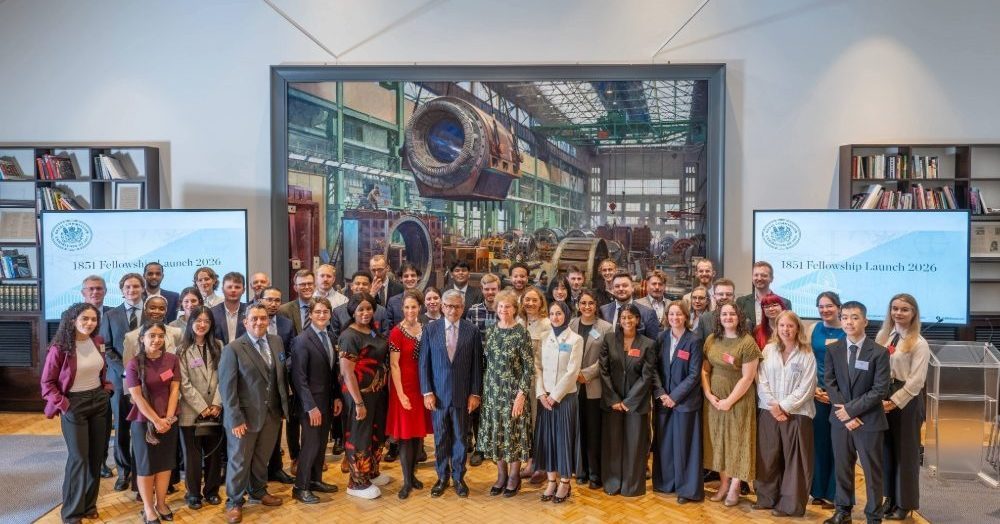
The Royal Commission for the Exhibition of 1851 has announced its 2026 cohort of Fellows, supporting researchers, industrial innovators, entrepreneurs, designers and technical educators whose work is addressing a diverse range of scientific, technological and societal challenges.
The 2026 Fellows are working across fields including astrophysics, ecology, plant science, advanced materials, clean energy, healthcare, artificial intelligence and cybersecurity. The cohort encompasses Research, Brunel, Industrial, Industrial Design, Enterprise, Technical Teaching, Built Environment Fellows and MSc students.
Together, they represent the breadth of the Royal Commission’s fellowship programmes, which support emerging talent across fundamental research, engineering, industrial innovation, design, entrepreneurship and technical education. The new Fellows join a community whose origins date back to the Commission’s foundation in 1850 by Prince Albert, continuing a long-standing commitment to developing the people and ideas that can help shape the future.
John Lavery, Secretary at the Royal Commission, said: “Each year, our Fellows remind us of the extraordinary range of talent and ideas emerging across the UK. The 2026 cohort brings together researchers, designers, entrepreneurs and educators tackling challenges from fundamental science to new technologies and industrial innovation. We are delighted to support them at this important stage of their careers and look forward to seeing where their ideas and ambitions lead.”
Since 1850 by Prince Albert, the Royal Commission has supported generations of scientists, engineers, innovators and educators at pivotal stages of their careers. Its distinguished alumni include Nobel laureates Peter Higgs and Paul Dirac, and physicist Ernest Rutherford. The 2026 Fellows continue this tradition, bringing together emerging talent with the opportunity to develop their ideas, expertise and ambitions while becoming part of a community that can support and inspire their future progress.
Applications are open now for the 2027 Industrial Fellowships, Research Fellowships, Brunel Fellowships and Industrial Design Studentships.
Research Fellows
The 2026 Research Fellows are pursuing fundamental research across science and engineering.
Dr Yonadav Barry Ginat, University of Oxford
Our resonant galactic centre
Dr Yuyang Huang, University of Oxford
Navigating complex optimization landscapes: Control, particle systems, and low-dimensional structure
Dr Duncan O’Brien, University of Sheffield
Ecological time lags and their importance for causal inference
Dr Ally Peccia, University of St Andrews
Novel isotope approach reveals climatic forcing of large volcanic eruptions
Dr Jessica Pritchard, Lancaster University
Rubisco regulation during the transition to CAM photosynthesis
Dr James Rawson, King’s College London
Could our ancestors hear dinosaurs? Modelling hearing across mammalian origins
Dr Gabriela Carvalho Silva, University of Warwick
Towards a new generation of stellar age calibrators
Dr Christopher Woodgate, University of Cambridge
Designing sustainable permanent magnet materials using machine-learned interatomic potentials
Dr Eeman Al-Ameen, Loughborough University (Brunel Fellow)
Making Cement Count: Novel Dematerialisation Strategy for Concrete Infrastructure Components
Industrial Fellows
The 2026 Industrial Fellows are working in partnership with companies and universities to address challenges with direct industrial applications.
Morgan Asan, Structural Adhesives Ltd and University of Leicester
Development of self-sensing adhesive materials for predictive maintenance in AI hardware
Oscar Berger, Arda Biomaterials and Queen Mary University of London
Protein nanocomposites derived from waste spent grain, and their application in novel biodegradable devices
Joshua Ellingford, Plasma Quest Ltd and University of York
Advancing low temperature thin film deposition
Rhianne Henderson, Coherence Neuro and University of Cambridge
A wearable neural interface for slowing melanoma progression
Sonia Higginson, Notpla and Imperial College London
Beyond Plastic: Innovating next-generation natural barrier coatings for paper packaging
Toby Hodges, Johnson Matthey and University of Oxford
Next generation CO2 electrolyser: Enabling stable operation through understanding catalyst-ionomer interactions
Susannah Krzyzanowski, Perspectum Ltd and University College London
Developing quantitative MRI to improve diagnosis, understanding, monitoring and treatment of superficial siderosis
Jacob Simms, GSK and University of Glasgow
Development of peptidomimetic antibody-drug conjugate linkers for improved target specificity and plasma stability
Ridhima Raina, GSK and University of Strathclyde
Photocatalytic approaches towards late-stage isotope labelling
Chloe Verity, Lubrizol and University of Sheffield
Generating a fundamental understanding of coatings formulations in aqueous media
Rovena Walichchoru Evayage, Resurrect Bio and Imperial College London
Engineering plant immune receptors for durable resistance to necrotrophic pathogens
Alongside the 2026 Fellows, the Royal Commission is also supporting the next generation of talent through a three-year pilot funding partnership with the Royal College of Music (RCM). The partnership provides studentships for the MSc in Performance Science, supporting Kenneth Querns, Grace Trimming, Jasmine Habgood and Nathan Li as they undertake research at the intersection of science, performance and human potential.